Personal Trader
ARCHITECTURE.
How Personal Trader thinks and acts: an LLM brain inside a trading harness that connects analysis, tools, and execution.
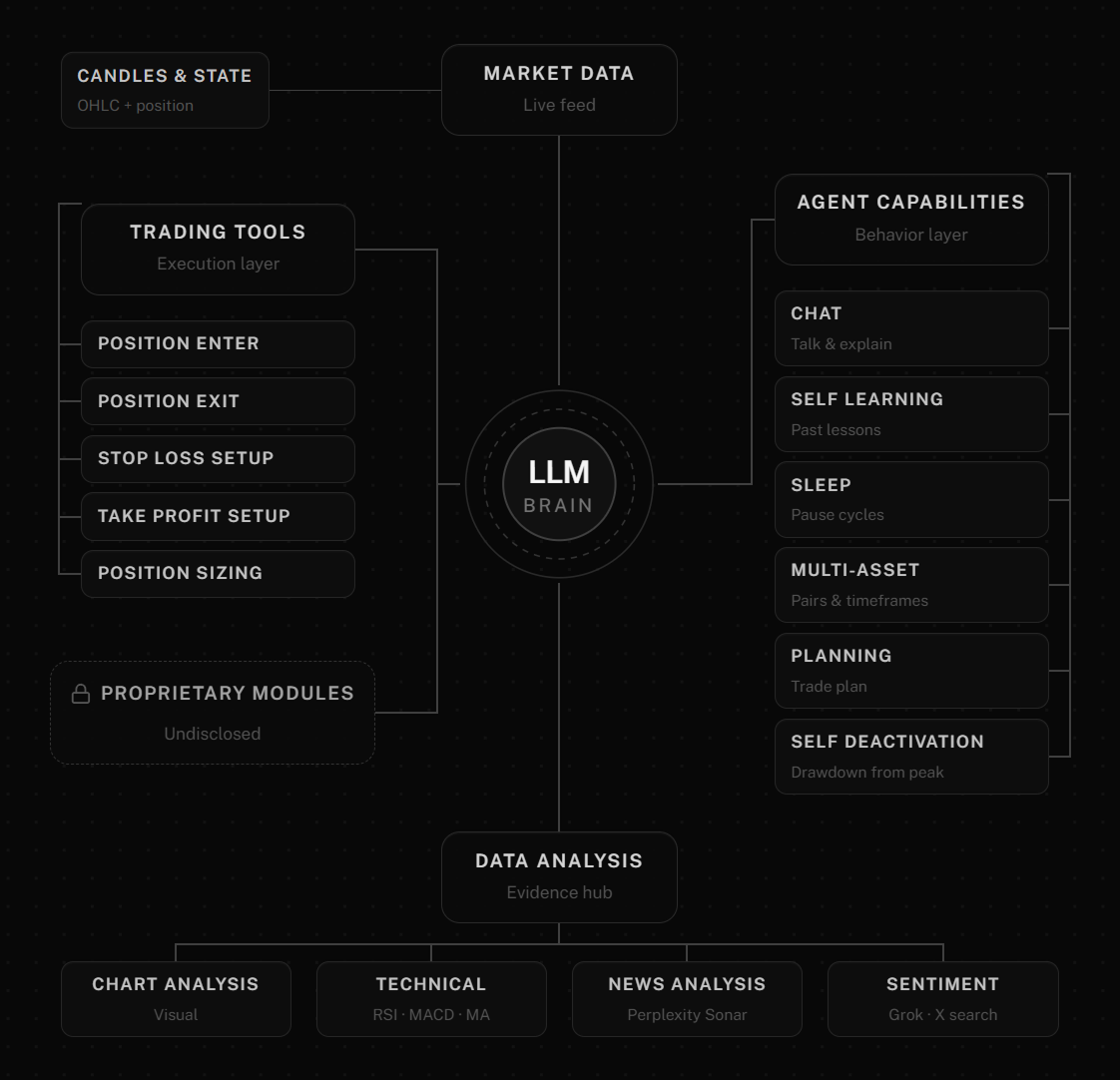
Personal Trader is built around a central language model that acts as the decision brain. It does not fire trades blindly. It sits inside a trading harness: a structured layer that connects the brain to live market data, analysis modules, execution tools, and the capabilities you configure.
Think of the harness as the operating system for your trader. The brain chooses what to run and when. The harness makes sure every action follows your rules, uses the right inputs, and leaves a clear trail you can review in the dashboard.
Personal Trader Architecture
1.The LLM brain
At the center is the LLM brain. On each decision cycle it reads context from the harness, weighs analyst outputs, and chooses the next action: enter, hold, exit, resize, update protection levels, or stand aside. Decisions follow a chain-of-thought reasoning path; that reasoning is stored so you can see why a move was made, not just what happened.
2.Market data feed
The harness streams structured market data into the brain: closed candles, price action, open position state, and performance context. This keeps decisions tied to what the market actually did, not stale assumptions.
3.Trading tools
When the brain commits to a plan, the harness exposes execution tools it can call:
- Position enter: open a new long or short within your size and side limits
- Position exit: close an open trade when conditions change
- Stop loss setup: define or update downside protection
- Take profit setup: lock in targets as the trade develops
- Position sizing: scale entries, adds, or reductions within your max investment cap
4.Data analysis branch
Before committing, the brain can request evidence from parallel analysis modules. You enable the ones you want per trader:
- Chart analysis (visual): reads rendered chart snapshots for structure, levels, and price behavior
- Technical analysis: indicator frames such as RSI, MACD, and moving averages aligned to your timeframe
- News analysis: live news fetch and summarization via Perplexity Sonar for pair-relevant headlines
- Sentiment analysis: broad X sentiment search via Grok for crowd mood around your market
Analyst outputs merge into combined evidence the brain uses before any enter, hold, or exit call. Fewer modules means faster steps. More modules means richer context at higher credit use.
5.Agent capabilities
- Chat: talk to your trader, refine strategy, and ask for plain-language explanations
- Self learning: lessons from past runs feed back into later decisions within guardrails you set
- Sleep: pause decision cycles when markets or schedules do not fit your plan
- Multi-asset: configure different pairs and timeframes per trader instance
- Planning: maintain a trade plan and amendments the brain follows across candles
- Self deactivation: set a drawdown limit from your performance peak. If the trader loses that much from its high-water mark, it deactivates itself until you turn it back on
6.Proprietary technology
The diagram shows the harness modules we document openly. A proprietary hub connects to the LLM brain the same way as the other sections, but its branch is deliberately left unexplained. These modules cover data preparation, signal conditioning, performance tuning, and decision weighting. They run continuously to improve decision quality and reliability. We do not publish how they work, what they contain, or how they are wired. That layer is Yeager IP and stays off the public docs.
7.What happens on each cycle
When a new closed candle arrives and your trader is awake, the harness wakes the brain. Hard risk checks run first (for example stop loss or take profit touched inside the candle). Then enabled analysts gather evidence in parallel. The brain evaluates, sizes the trade if needed, sets or updates protection, and the harness executes paper or live orders on your exchange connection.