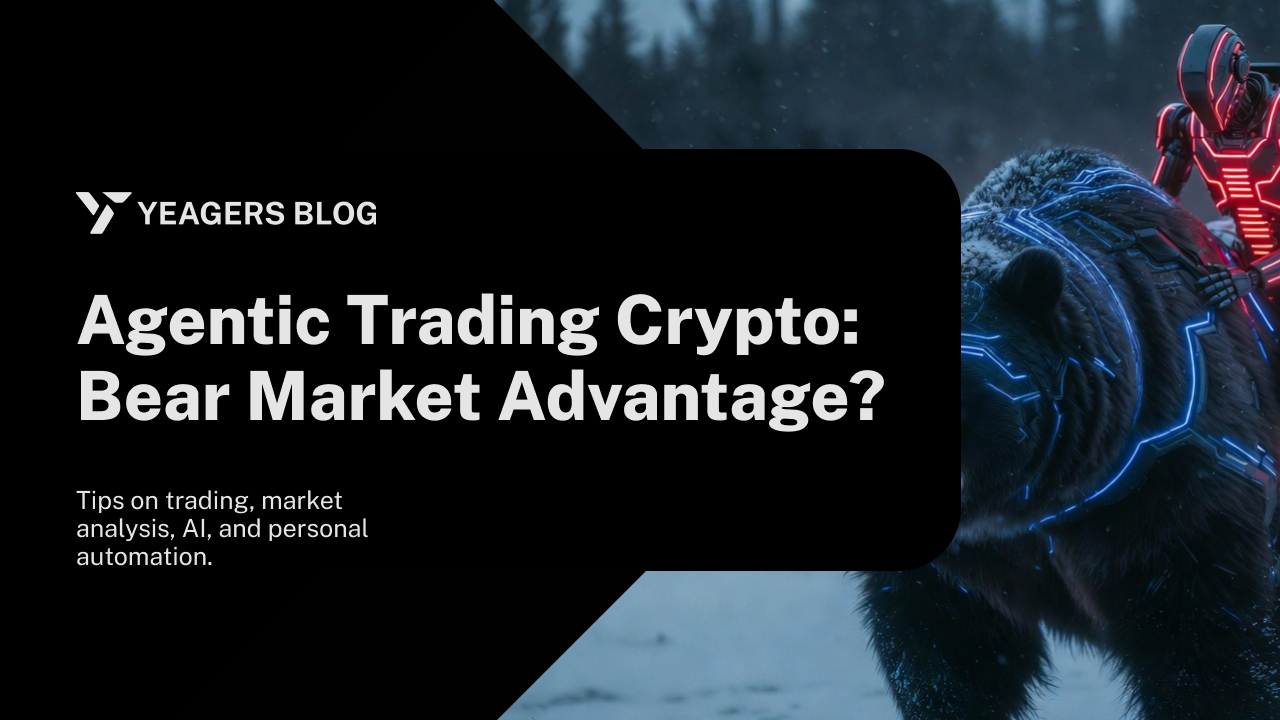
Agentic Trading Crypto: Bear Market Advantage?
"In the volatile seas of cryptocurrency, especially during a bear market, the ability to adapt, learn, and execute without emotion can be the ultimate compass. As market dynamics shift rapidly, an autonomous and intelligent trading agent, according to Forbes, offers a crucial edge, transforming uncertainty into calculated opportunities by constantly refining its strategies."
1. Introduction
The cryptocurrency market, known for its extreme volatility, presents both immense opportunities and significant challenges for traders. While bull markets often mask flaws in strategy, bear markets brutally expose them, demanding precision, resilience, and an almost superhuman ability to make rational decisions amidst panic and uncertainty. It is in this challenging environment that the concept of "agentic trading crypto" emerges as a potential game-changer. Moving beyond traditional algorithmic bots, agentic AI systems are designed not just to follow rules but to understand goals, plan sequences of actions, learn from experience, and autonomously adapt their strategies in real-time. This sophisticated approach holds the promise of not just surviving a crypto bear market but potentially thriving within it, turning market downturns into strategic advantages.
2. Understanding agentic trading
What is an agentic AI system?
An agentic AI system represents a significant leap forward from conventional algorithmic trading. At its core, an agentic system is an artificial intelligence designed to be goal-oriented, self-governing, and capable of operating with a degree of autonomy. Unlike a typical trading bot that executes predefined rules, an agentic AI has a deeper understanding of its objectives and can strategize to achieve them. It incorporates elements of memory, allowing it to recall past actions and their outcomes, and a planning module that enables it to break down complex goals into smaller, manageable steps. Crucially, these agents can utilize various "tools" – such as API calls to exchanges, on-chain data analysis tools, or even sentiment analysis models – to gather information, make decisions, and execute trades without constant human oversight. This ability to reason, adapt, and act independently makes them powerful contenders in the fast-paced crypto landscape.
Evolution in crypto markets
The integration of AI into crypto markets has evolved rapidly. Initially, we saw simple trading bots executing arbitrage or trend-following strategies based on explicit programming. These bots, while effective within their narrow parameters, lacked the flexibility to adapt to unprecedented market shifts. The next phase introduced more advanced machine learning models, capable of identifying complex patterns and making probabilistic predictions. Agentic AI represents the current frontier, where systems are not just predictive but prescriptive and adaptive. They can interpret novel market conditions, adjust their risk parameters on the fly, and even experiment with new strategies, continuously learning and improving their performance. This evolution signifies a move towards increasingly autonomous and intelligent trading entities capable of navigating the intricate dynamics of decentralized finance and centralized exchanges alike.
3. The bear market challenge
Navigating volatility and uncertainty
Bear markets in crypto are characterized by sustained downward price pressure, often accompanied by heightened volatility, decreased liquidity, and pervasive fear among investors. Navigating these conditions is notoriously difficult for human traders. Psychological biases such as fear of missing out (FOMO) on a rebound, or holding onto losing positions too long in hopes of recovery, often lead to suboptimal decisions. The market’s unpredictable nature, with sudden flash crashes or temporary rallies, demands constant vigilance and the ability to make rapid, unemotional judgments. For many, a bear market is a period of capital preservation rather than aggressive growth, but agentic systems offer a different perspective.
Limitations of traditional approaches
Traditional trading methods, whether manual or relying on basic bots, often fall short in a bear market. Manual trading is susceptible to human emotions, fatigue, and the sheer volume of data analysis required to make informed decisions. Simple algorithmic bots, while efficient for specific tasks, are constrained by their rigid programming. They might execute a pre-defined strategy perfectly, but if market conditions shift dramatically – as they often do in a bear market – these bots can fail to adapt, leading to significant losses. They lack the intelligence to fundamentally alter their approach, learn from new data, or devise novel strategies to counteract adverse trends, highlighting the need for more sophisticated, adaptable solutions like agentic trading.
4. Agentic trading's edge in a downturn
Automated strategy adaptation
One of the most compelling advantages of agentic trading in a bear market is its capacity for automated strategy adaptation. Unlike static algorithms, agentic AI continuously monitors a vast array of market signals, from on-chain analytics and order book depth to social sentiment and macroeconomic indicators.
- Dynamic analysis: These agents can process real-time market data, identifying emerging trends, anomalies, and potential reversals with far greater speed and accuracy than a human. They can analyze historical patterns of past bear markets and apply learned insights to current conditions, predicting shifts in momentum or liquidity.
- Adaptive execution: Based on this dynamic analysis, an agentic system can automatically adjust its trading parameters. This might include tightening stop-loss orders, reducing position sizes, shifting from long to short positions, or even pausing trading altogether during periods of extreme uncertainty. This continuous self-correction ensures the strategy remains optimal even as market dynamics evolve rapidly.
Enhanced risk management
Risk management is paramount in a bear market, and agentic systems excel in this area by integrating sophisticated controls and proactive monitoring.
- Preemptive identification: Agents can analyze market structure and historical data to preemptively identify potential risks, such as impending liquidity crunches, cascading liquidations, or significant sell walls. This allows them to adjust exposure before a major downturn occurs, rather than reactively.
- Granular control: They can implement complex risk models, such as Value at Risk (VaR), conditional VaR, or maximum drawdown limits, applying them with unparalleled precision. If a predefined risk threshold is breached for a specific asset or the entire portfolio, the agent can automatically trim positions, rebalance, or hedge, ensuring capital preservation is prioritized.
Exploring arbitrage and shorting opportunities
Bear markets, while challenging, also create unique opportunities that agentic systems are uniquely positioned to exploit.
- Cross-exchange arbitrage: Increased volatility and temporary market inefficiencies can lead to price discrepancies across different exchanges. Agentic systems can scan multiple exchanges simultaneously, identify these fleeting arbitrage opportunities, and execute trades at high speed, profiting from the differential.
- Effective short-selling: Short-selling, or betting on price declines, is a key strategy in a bear market. Agentic agents can execute complex shorting strategies with precise timing, identify optimal entry and exit points, and manage the associated risks (like sudden short squeezes) through dynamic hedging and adaptive stop-losses, effectively capitalizing on downward price movements.
Eliminating emotional bias
One of the most significant psychological hurdles for human traders in a bear market is the battle against emotions like fear, greed, and panic. Agentic trading systems, by their very nature, are devoid of these biases. Their decisions are based purely on data, pre-programmed logic, and continuous learning algorithms. This emotionless execution leads to rational, consistent, and disciplined trading, preventing costly mistakes driven by FUD (fear, uncertainty, doubt) or irrational exuberance during temporary rallies.
5. Key components of an effective agentic trading system
To function effectively, particularly in the unforgiving landscape of a crypto bear market, an agentic trading system relies on several critical components working in synergy.
-
Data ingestion and processing: The foundation of any intelligent system is high-quality, real-time data. An effective agentic system must seamlessly ingest massive amounts of data, including historical price data, real-time order book information, on-chain metrics, sentiment data from social media, news feeds, and even macroeconomic indicators. This data must be cleaned, normalized, and processed efficiently to be fed into the agent's decision-making modules.
-
Goal setting and planning: Unlike simple bots, agentic systems are given high-level goals (e.g., "maximize risk-adjusted returns," "preserve capital during a downturn"). The system then needs a robust planning module to break these overarching goals into a sequence of actionable steps, considering current market conditions and available tools. This involves anticipating future states and selecting the most optimal path.
-
Memory and learning: A crucial differentiator for agentic AI is its capacity for memory and continuous learning. It retains information about past trades, market reactions to specific events, and the outcomes of its own strategies. Through machine learning techniques, particularly reinforcement learning, the agent can learn from these experiences, adapt its internal models, and improve its performance over time, making it more resilient and effective in future market cycles.
-
Tool utilization: Agentic systems aren't isolated entities; they interact with the external world through various "tools." These include APIs for cryptocurrency exchanges (to place orders, check balances), data providers (for market and on-chain data), and potentially even smart contracts on decentralized finance (DeFi) platforms for complex strategies like yield farming or decentralized lending/borrowing. The agent decides which tools to use and how to use them to achieve its goals.
-
Execution layer: The final component is a reliable and low-latency execution layer. Once the agent has made a decision, it needs to execute trades swiftly and accurately across various exchanges or DeFi protocols. This requires robust infrastructure to handle potential network congestion, API rate limits, and ensure orders are filled at the desired prices, especially crucial in fast-moving, illiquid bear markets.
6. Risks and considerations
While agentic trading offers significant advantages, it is not without its risks and critical considerations. Understanding these limitations is vital for successful implementation.
Technical failures and bugs
Even the most sophisticated AI is reliant on its underlying code and infrastructure. Technical failures, software bugs, or even unexpected interactions between different modules can lead to incorrect decisions or execution errors, potentially resulting in substantial financial losses. Robust testing, continuous monitoring, and fail-safes are essential. The "garbage in, garbage out" principle also applies: if the data fed to the agent is flawed or manipulated, its output will be equally unreliable.
Over-optimization and curve fitting
There's a persistent danger that agentic models, particularly those based on historical data, might be over-optimized to past market conditions. This "curve fitting" can lead to strategies that perform exceptionally well in backtests but fail spectacularly in live trading environments when market dynamics diverge from historical patterns. Agents must be designed with generalization in mind, constantly validating their models against new, unseen data, and incorporating mechanisms to detect and mitigate over-optimization.
Regulatory uncertainty
The regulatory landscape for cryptocurrency is still evolving, and the use of advanced AI in trading adds another layer of complexity. Future regulations might impose restrictions on automated trading systems, require specific licensing, or demand greater transparency in how these systems operate. Staying compliant and being prepared for potential regulatory shifts is a significant challenge.
Market manipulation
Despite their advanced capabilities, agentic systems can still be vulnerable to sophisticated market manipulation tactics. Coordinated whale movements, wash trading, or spoofing can generate misleading signals that even an intelligent agent might interpret incorrectly, leading it to make disadvantageable trades. Designing agents to recognize and defend against such manipulations is an ongoing area of research and development.
7. Future outlook
The trajectory for agentic trading in crypto is one of continuous innovation and integration. As the technology matures, its impact will likely expand significantly.
Advancements in AI and blockchain integration
Further advancements in AI, particularly in areas like explainable AI (XAI) and federated learning, will make agentic systems more transparent, robust, and capable of collaborative intelligence. The tight integration with blockchain technology will enable agents to interact more seamlessly with decentralized applications, participate in governance, and manage assets across various DeFi protocols with greater security and efficiency. We may see the emergence of decentralized autonomous organizations (DAOs) governed by agentic AI, further blurring the lines between code and entity.
Accessibility and democratisation
As the technology becomes more refined and user-friendly, agentic trading tools could become more accessible to a wider audience, moving beyond institutional players and large hedge funds. This democratisation could empower individual investors with sophisticated AI capabilities, evening the playing field and allowing more participants to navigate complex markets with advanced strategies. However, this also raises questions about market concentration and the potential for increased systemic risks if too many agents converge on similar strategies.
Ethical implications
The rise of highly autonomous trading agents also brings forth critical ethical considerations. Questions around accountability for erroneous trades, the potential for AI-driven flash crashes, and the fairness of markets dominated by superior AI will become increasingly pertinent. Ensuring transparency, auditability, and human oversight in key decision points will be crucial for the responsible development and deployment of agentic trading systems in the future.
8. Conclusion
Agentic trading represents a powerful evolution in how we approach the volatile cryptocurrency markets, particularly during challenging bear market conditions. Its core strength lies in its ability to autonomously adapt strategies, manage risk with precision, identify nuanced opportunities like arbitrage and shorting, and completely eliminate the detrimental impact of human emotions. By continuously learning and evolving, these intelligent systems offer a compelling advantage for not just weathering market downturns but potentially capitalizing on them. However, realizing this potential requires a keen awareness of the inherent technical, regulatory, and ethical risks. As AI continues to advance and integrate more deeply with blockchain ecosystems, agentic trading is poised to redefine the landscape of digital asset management. For those willing to embrace its complexities and continually refine its implementation, agentic trading in crypto may well be the strategic advantage that transforms fear into calculated opportunity during the next bear market.
Keep reading