Mastering Polymarket Trading with LLM AI
"The future of prediction lies not just in aggregating human wisdom, but in augmenting it with the unparalleled data processing and pattern recognition capabilities of artificial intelligence. Integrating LLMs into platforms like Polymarket could redefine how we perceive and profit from probabilistic outcomes," according to Dr. Kai-Fu Lee.
1. Introduction: The Dawn of AI-Powered Prediction Markets
The world of financial trading has consistently evolved, driven by technological advancements and innovative platforms. Among the most intriguing recent developments are prediction markets, where participants bet on the outcome of future events. Polymarket stands out as a leading decentralized platform in this arena, offering a unique opportunity for individuals to leverage their insights into everything from politics and finance to sports and pop culture. However, even the sharpest human intellect can be overwhelmed by the sheer volume of information required to make consistently profitable predictions. This is where the transformative potential of Large Language Models (LLMs) comes into play. By harnessing the sophisticated analytical capabilities of AI, traders can move beyond traditional methods, gaining an unprecedented edge in interpreting market signals, identifying trends, and managing risk. This blog post delves into how LLM AI can be leveraged to master Polymarket trading, providing a comprehensive guide for both seasoned traders and curious newcomers.
2. Unpacking Polymarket: The Landscape of Predictive Trading
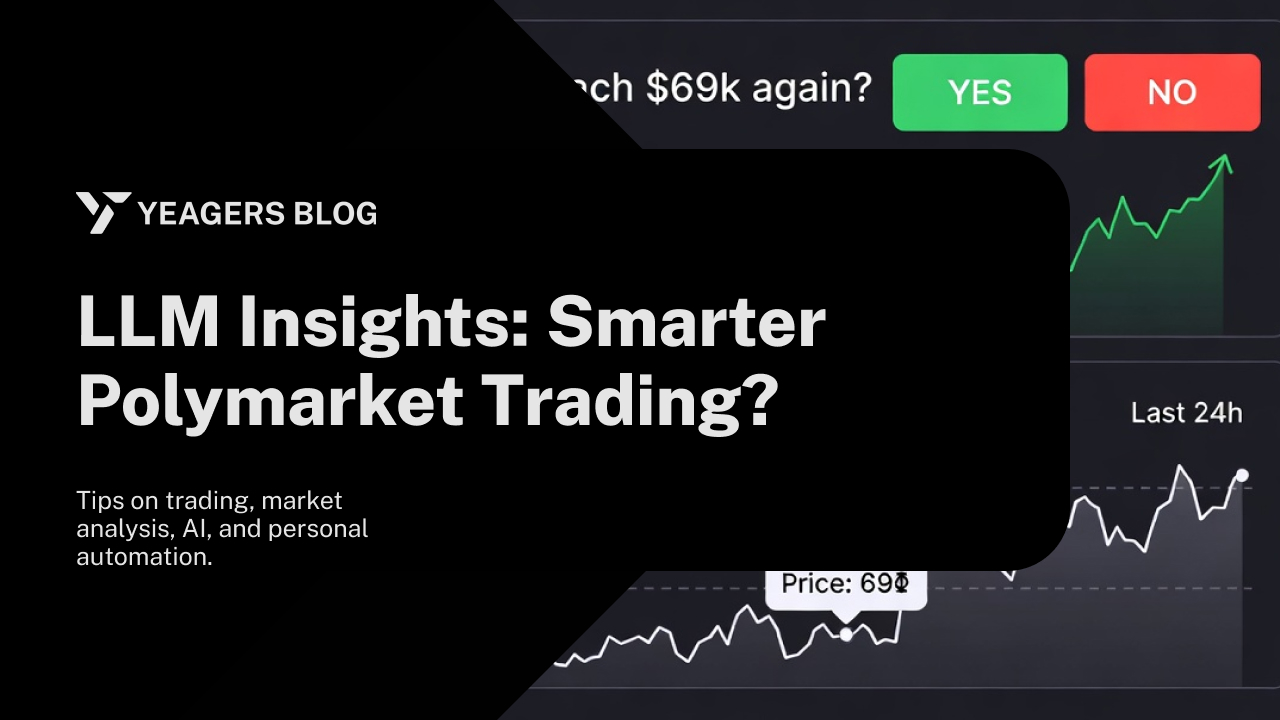
Polymarket is a decentralized information market platform built on blockchain technology, specifically utilizing the Polygon network for its efficiency and low transaction costs. It allows users to create and trade shares in the outcomes of real-world events. Participants buy "yes" or "no" shares based on their belief in an event occurring or not occurring. If an event resolves as "yes," "yes" shares become worth 0, and vice versa.
How Polymarket operates
At its core, Polymarket operates on the principles of market efficiency and the wisdom of crowds. Each market has a resolution date and a clear set of rules for determining the outcome. The price of a share reflects the aggregated probability assigned to that outcome by all market participants. For instance, if "yes" shares for an event are trading at $0.70, the market collectively believes there's a 70% chance of that event occurring. Traders profit by buying shares when they believe the market is mispricing an outcome and selling them when the price reflects their corrected probability. The decentralized nature ensures transparency and censorship resistance, fostering a truly open market for ideas and predictions.
The appeal of decentralized markets
The allure of Polymarket lies in its transparency, accessibility, and the direct alignment of incentives. Unlike traditional financial markets, which can be opaque and controlled by intermediaries, Polymarket empowers individual participants. This decentralized structure fosters a more honest representation of collective belief, often proving to be more accurate than traditional polling or expert predictions. However, navigating these markets still requires significant research, data analysis, and an ability to synthesize diverse information streams quickly and effectively—tasks where LLMs truly shine.
3. The Power of Large Language Models (LLMs)
Large Language Models are advanced AI systems trained on vast amounts of text data, enabling them to understand, generate, and process human language with remarkable fluency and coherence. These models, like OpenAI's GPT series or Google's PaLM, have moved far beyond simple chatbots, becoming powerful tools for complex data analysis, content creation, and even problem-solving.
Beyond simple chatbots
Initially, LLMs gained public attention for their ability to generate human-like text, answer questions, and engage in conversational interfaces. However, their true power extends to sophisticated analytical tasks. They can summarize lengthy articles, extract key information from unstructured text, translate languages, and even identify subtle patterns and relationships within complex datasets that might escape human observation. This capability makes them invaluable for processing the high volume of qualitative and quantitative data relevant to prediction markets.
LLMs in data synthesis and analysis
For prediction market traders, the ability of LLMs to synthesize information is revolutionary. An LLM can ingest news articles, social media feeds, political statements, economic reports, and historical data, then process this disparate information to identify underlying sentiments, potential biases, and emerging narratives. This allows traders to quickly form a comprehensive understanding of an event's context, rather than spending hours sifting through information manually. By analyzing how language is used and how events are discussed across various sources, LLMs can provide a more nuanced and holistic view of public perception and potential outcomes.
4. Synergizing LLM AI with Polymarket Trading
Integrating LLM AI into Polymarket trading strategies offers a multi-faceted approach to gaining an information advantage and improving decision-making accuracy.
Enhanced market analysis
LLMs can be trained or fine-tuned to scour the internet for relevant news, expert opinions, government reports, and historical data pertinent to specific Polymarket questions. For example, for a market on an election outcome, an LLM could analyze polling data, candidate statements, campaign funding, and social media buzz to predict shifts in voter sentiment more accurately than manual analysis. This allows for a deeper, more comprehensive understanding of market dynamics.
Real-time sentiment deciphering
One of the most powerful applications of LLMs is their capacity for sentiment analysis. They can monitor social media platforms, forums, and news comments in real-time to gauge public sentiment towards a particular event or entity. A sudden shift in sentiment, often detectable by an LLM before it fully manifests in market prices, can signal an impending change in probabilities. This real-time insight provides a critical advantage, enabling traders to react swiftly to evolving perceptions.
Predictive modeling and pattern recognition
Beyond sentiment, LLMs can identify complex patterns and correlations within historical market data and external information. They can link seemingly unrelated events or trends to potential outcomes, constructing sophisticated predictive models. For example, an LLM might discover a correlation between a specific economic indicator and the likelihood of a central bank policy change, which in turn impacts a Polymarket related to interest rates. This algorithmic capability to find subtle connections enhances market forecasting beyond human capacity.
Automated risk management and strategy adaptation
LLMs can also assist in risk assessment by analyzing potential scenarios and their probabilities. They can simulate outcomes based on various inputs, helping traders understand the potential upside and downside of their positions. Furthermore, as new information emerges, an LLM can quickly re-evaluate existing strategies, suggesting adjustments or even completely new approaches to optimize returns and mitigate losses. This adaptive capability ensures that trading strategies remain agile and responsive to the dynamic nature of prediction markets.
5. Practical Strategies for LLM Integration
Implementing LLM AI for Polymarket trading involves several key steps, from data preparation to continuous learning.
Data collection and preprocessing
The foundation of any effective LLM strategy is high-quality data. This involves gathering diverse data sources such as news articles, social media feeds, historical Polymarket data, financial reports, and expert analyses. The data then needs to be preprocessed to remove noise, standardize formats, and structure it in a way that the LLM can efficiently consume and interpret.
Model training and fine-tuning
While pre-trained LLMs are powerful, fine-tuning them on domain-specific data (e.g., Polymarket historical outcomes, specific event types) can significantly enhance their performance. This involves feeding the model with relevant examples to improve its ability to understand the nuances of prediction market language and dynamics, thereby making more accurate predictions.
Strategy development and backtesting
Once an LLM is trained, traders can develop specific strategies based on its outputs. This could involve automated alerts for sentiment shifts, probabilistic forecasts for specific markets, or recommendations for position sizing. These strategies should then be rigorously backtested against historical data to evaluate their effectiveness and identify areas for improvement before deployment in live trading.
Ethical considerations and continuous learning
It is crucial to consider the ethical implications, such as potential biases in training data or the responsible use of AI for trading. LLMs are not infallible and require continuous monitoring. Traders should regularly feed new data into their models, update their training, and adapt to new market conditions and LLM advancements. This iterative process ensures the AI remains effective and relevant.
6. Challenges and Future Outlook
While the potential of LLM AI in Polymarket trading is immense, several challenges need to be addressed to unlock its full capabilities.
Data quality and bias
The accuracy of LLM outputs is heavily dependent on the quality and impartiality of its training data. Biased or incomplete data can lead to skewed predictions and flawed trading decisions. Ensuring diverse, reliable, and continuously updated data sources is paramount.
Computational overhead
Running and fine-tuning sophisticated LLMs can be computationally intensive and costly, requiring significant computing resources. This might be a barrier for individual traders without access to powerful infrastructure or cloud computing services.
Regulatory landscape
The regulatory environment for AI-driven trading, especially in decentralized prediction markets, is still evolving. Traders must remain aware of potential legal and ethical guidelines as these technologies become more integrated into financial systems.
7. Conclusion: The Intelligent Trader's Edge
The integration of Large Language Models into Polymarket trading represents a significant leap forward in how participants can approach prediction markets. By leveraging AI's ability to process vast amounts of unstructured data, discern subtle patterns, and interpret real-time sentiment, traders can achieve an unprecedented information advantage. While challenges related to data quality, computational demands, and evolving regulations persist, the strategic application of LLM AI offers a powerful tool for enhancing market analysis, improving predictive accuracy, and refining risk management. As these technologies continue to advance, the intelligent trader who embraces LLM AI will undoubtedly gain a distinct edge, transforming the landscape of decentralized prediction markets and paving the way for a more sophisticated and data-driven approach to forecasting the future.
Keep reading