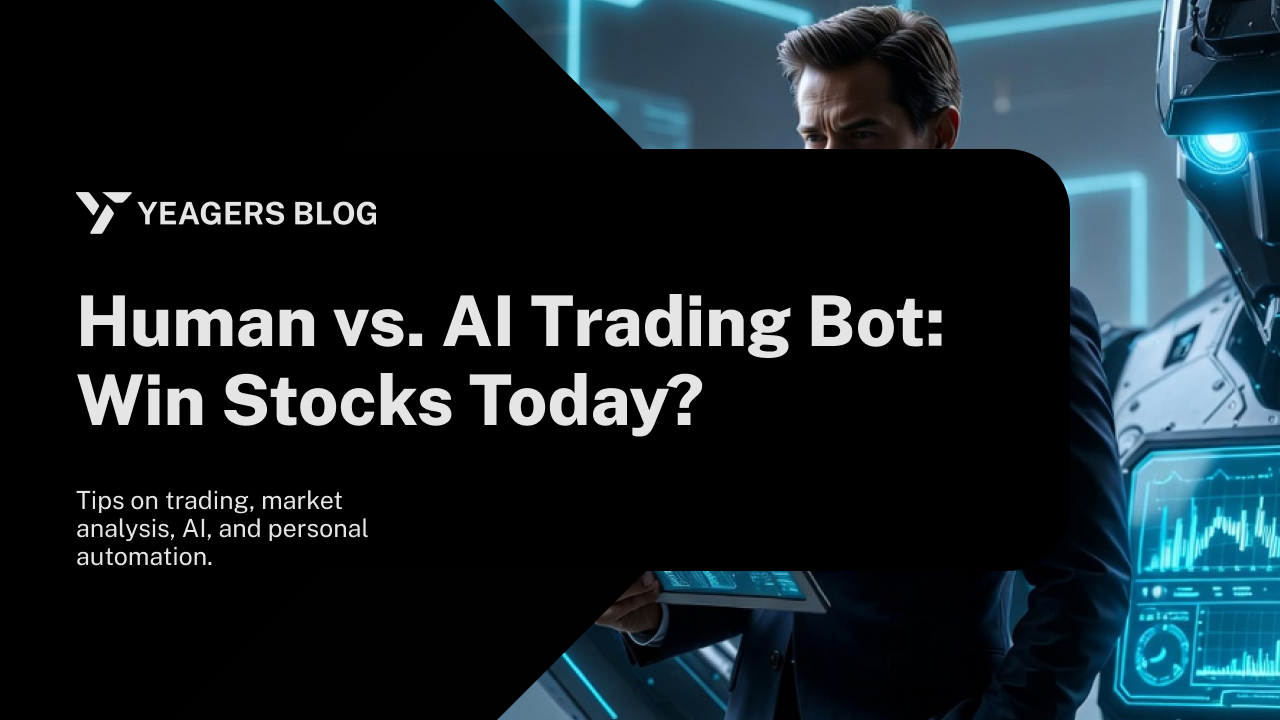
Human vs. AI trading bot: Win stocks today?
"In the rapidly evolving landscape of modern finance, the critical question is not whether artificial intelligence will replace human traders, but rather how their synergistic capabilities can be harnessed to unlock unprecedented levels of market insight and investment efficiency," according to Forbes Advisor.
1. Introduction
The world of stock trading has always been a thrilling arena, a delicate dance between risk and reward. For centuries, human intuition, experience, and sharp analytical skills were the sole determinants of success. However, the dawn of the 21st century brought with it a formidable challenger: the AI trading bot. These sophisticated algorithms, powered by artificial intelligence and machine learning, are rapidly reshaping how we interact with financial markets. The burning question for many aspiring and seasoned investors alike is no longer if AI will impact trading, but who holds the ultimate advantage in today's fast-paced stock market – the nuanced human trader or the lightning-fast AI bot? This blog post delves into the core strengths and weaknesses of both, exploring their potential for solitary success and the intriguing prospects of a collaborative future.
2. The human edge: Intuition and adaptability
Despite the rise of advanced technology, human traders still possess unique qualities that AI struggles to replicate. These attributes often become most apparent during times of market uncertainty or unprecedented events.
- Emotional intelligence: Human traders can interpret subtle market sentiments that go beyond raw data. They can gauge the mood of the market, understand the implications of geopolitical tensions, and read between the lines of corporate announcements. This qualitative understanding often provides crucial context that pure quantitative models might miss, allowing for more nuanced decision-making.
- Creativity and strategy: Developing novel investment theses, identifying emerging trends before they become mainstream, or formulating unconventional strategies are hallmarks of human ingenuity. Traders can think outside the box, adapt their approach based on dynamic circumstances, and even create markets where none previously existed.
- Adaptability to Black Swan events: When unforeseen events like a global pandemic or a sudden economic crisis occur, AI models, trained on historical data, can falter. Human traders, with their ability to reason, synthesize disparate information, and make judgments based on limited or ambiguous data, are often better equipped to navigate and adapt to such unprecedented "Black Swan" events.
- Ethical considerations: Human traders inherently understand and navigate the ethical landscape of finance. They can make discretionary calls based on long-term vision, regulatory compliance, and personal values, which extend beyond the immediate profit-and-loss metrics that typically drive an AI trading bot.
3. The AI trading bot's power: Speed and precision
AI trading bots leverage computational power and advanced algorithms to execute trades with a speed and accuracy that no human can match. Their advantages are largely rooted in their technical capabilities and unwavering objectivity.
- Algorithmic execution: AI bots excel at high-frequency trading (HFT), executing thousands of trades per second. This unparalleled speed allows them to capitalize on tiny price discrepancies and market inefficiencies that are imperceptible to human eyes, making them dominant in areas like arbitrage.
- Data analysis: These bots can process colossal amounts of market data – historical prices, news feeds, social media sentiment, economic indicators – in fractions of a second. They identify complex patterns and correlations that would take humans weeks or months to uncover, leading to highly informed and data-driven predictions.
- Elimination of emotion: One of the biggest pitfalls for human traders is emotional decision-making – fear leading to premature selling or greed driving reckless buying. AI bots are entirely devoid of emotions, adhering strictly to pre-defined parameters and mathematical models, ensuring disciplined and consistent execution.
- Backtesting and optimization: AI algorithms can rigorously backtest strategies against decades of historical data in minutes, identifying optimal parameters and potential weaknesses. This iterative process of testing and refinement significantly enhances the robustness and reliability of their trading approaches.
- Scalability: A single AI trading bot can manage multiple assets across various markets simultaneously, 24 hours a day, 7 days a week, without fatigue, distractions, or the need for breaks. This scalability allows for broad market coverage and continuous opportunity capture.
4. Key battlegrounds: Performance metrics
When comparing human traders and AI bots, several key performance metrics come into play, each highlighting their distinct capabilities and limitations.
- Volatility handling: In highly volatile markets, human traders might use discretion to avoid trades or adjust positions based on unfolding news. AI bots, while potentially designed with volatility parameters, might still struggle if market behavior deviates significantly from their training data, leading to unexpected losses.
- Return on investment (ROI): For short-term, high-volume strategies, AI bots often demonstrate superior ROI due to their speed and precision. However, for long-term, value-based investing, a human's ability to identify deep intrinsic value and hold through market noise can often outperform short-sighted algorithmic approaches.
- Risk management: Both humans and AI bots employ risk management strategies like stop-loss orders and diversification. However, human traders can override these based on unforeseen circumstances or intuitive understanding of systemic risk, while bots adhere rigidly to their programming, which can be a double-edged sword.
- Learning curve: Humans gain experience and improve over time through practice and reflection. AI bots, through machine learning, continuously learn and adapt from new data, potentially making them more efficient over extended periods, provided they are fed with diverse and relevant information.
5. The future: A symbiotic relationship
The prevailing sentiment among financial technology experts is that the future of stock trading lies not in a competition between humans and AI, but in a powerful collaboration. A hybrid approach promises to combine the best of both worlds.
- Hybrid models: Integrating AI's computational power for data analysis and execution with human oversight for strategic planning and emotional intelligence creates a formidable trading entity. Humans set the overarching goals and risk parameters, while AI executes the detailed operations.
- AI as an assistant: Traders can leverage AI as an advanced assistant, providing real-time market insights, identifying potential opportunities, flagging risks, and automating mundane tasks. This frees up human cognitive resources for higher-level strategic thinking and decision-making.
- Ethical AI development: As AI becomes more integrated, there's a growing focus on developing ethical AI. This involves ensuring transparency in how algorithms make decisions, preventing biases, and establishing clear accountability frameworks to build trust and ensure fair market practices.
- Continuous learning: Just as AI learns from new data, human traders can continuously learn from AI's analytical capabilities, refining their strategies and understanding of market dynamics. This creates a feedback loop where both entities evolve and improve together.
6. Choosing your path: What's right for you?
Deciding whether to rely on human trading skills, an AI bot, or a combination depends heavily on individual circumstances, goals, and risk appetite.
- Understanding your goals: Are you seeking rapid, short-term gains through active trading, or are you aiming for long-term wealth accumulation through passive investment? AI bots might be more suited for the former, while human-led strategies often excel in the latter.
- Risk tolerance: If you have a high tolerance for risk and are comfortable with the volatility inherent in algorithmic trading, an AI bot might appeal. If you prefer a more conservative, measured approach with discretionary overrides, a human-centric strategy may be better.
- Time commitment: Active trading, whether manual or supervised AI, requires significant time. If you prefer a truly hands-off approach, a fully automated AI bot might be attractive, though it still requires initial setup and periodic monitoring.
- Educational investment: Learning to trade effectively as a human demands extensive study and experience. While using an AI bot might seem simpler, understanding its parameters, limitations, and how to optimize it still requires a degree of financial literacy and technical understanding.
7. Conclusion
The debate between human traders and AI trading bots is not a zero-sum game. While AI bots undeniably offer unparalleled speed, precision, and data processing capabilities, human traders bring invaluable intuition, adaptability, and emotional intelligence to the table. In today's dynamic stock market, the most effective approach is increasingly a collaborative one – a symbiosis where AI enhances human decision-making and executes with efficiency, while humans provide the strategic oversight and ethical compass. Whether you choose to primarily engage as a human trader, deploy an AI bot, or harness the power of both, understanding their respective strengths is paramount to navigating the complexities of the stock market and improving your chances to win stocks today.
Keep reading