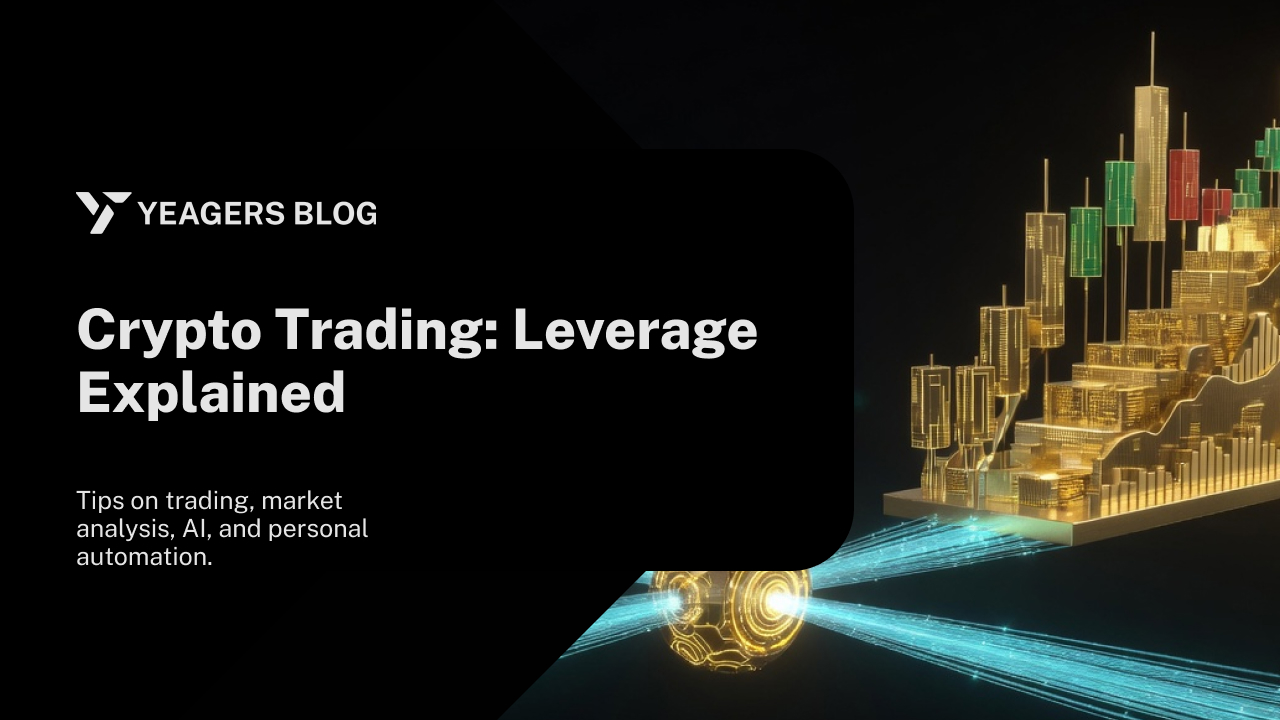
Crypto Trading: Leverage Explained
"Leverage is a potent financial tool, capable of magnifying returns and accelerating wealth creation, yet it simultaneously amplifies risk, demanding meticulous management and a profound understanding of its dual nature. It's a double-edged sword, where the promise of significant gains is inextricably linked to the potential for equally significant losses," according to Investopedia.
In the fast-paced, often volatile world of cryptocurrency trading, every edge counts. While many traders focus on fundamental analysis, technical indicators, or market sentiment, there's a powerful and often misunderstood tool that can dramatically impact a trader's potential gains—and losses: leverage. Often viewed with a mix of awe and apprehension, leverage allows traders to control larger positions with a relatively small amount of capital. It's a mechanism that can turn modest market movements into substantial profits, but conversely, can quickly wipe out an account if not managed with extreme care. This guide will demystify crypto leverage, explaining what it is, how it works, its benefits, its inherent risks, and how to approach it responsibly in your trading strategy.
1. Understanding Leverage in Crypto Trading
Leverage, in its simplest form, means using borrowed capital to increase your trading position beyond what your actual cash balance would allow. Think of it like a loan from your exchange specifically for trading. When you use leverage, you're essentially amplifying your buying or selling power.
What is leverage
Most crypto exchanges offer various leverage ratios, such as 2x, 5x, 10x, 50x, or even 100x. A 10x leverage, for example, means that for every 9, allowing you to control a 1,000 in your trading account and use 10x leverage, you can open a position worth $10,000. This amplification is what attracts many traders, as it offers the tantalizing prospect of larger returns from smaller price movements.
Initial margin and maintenance margin
When you open a leveraged position, a portion of your capital is set aside as 'initial margin.' This is the collateral that secures the borrowed funds. As your trade progresses, the exchange monitors your position against a 'maintenance margin.' If the market moves against your trade and your equity (the value of your collateral) falls below this maintenance margin requirement, you will face a "margin call." This is a request from the exchange to add more funds to your account to cover potential losses and prevent liquidation.
2. How Crypto Leverage Works
The mechanics of leverage are crucial to grasp before engaging in any leveraged crypto trading. It’s not just about multiplying profits; it’s about understanding the intricate interplay of capital, borrowed funds, and market movements.
Opening a leveraged position
When you decide to open a leveraged trade, you first choose your desired leverage ratio on the trading platform. For instance, if you want to trade Bitcoin (BTC) with 20x leverage, and you have 10,000 (20 x 500 serves as the initial margin.
Profit and loss calculation
Suppose BTC is trading at 10,000 position, you've essentially bought 0.2 BTC. If BTC's price rises by just 1% to 10,000 position would now be worth 100. Without leverage, a 1% gain on your initial 5. With 20x leverage, that same 1% move translates to a 20% gain on your initial capital (500 margin).
Understanding liquidation
The flip side is equally powerful. If BTC’s price drops by 1% to 10,000 position would now be worth 100. This 500 initial margin. As the price continues to move against you, your margin depletes. If your margin falls below a certain threshold (the maintenance margin), the exchange will automatically close your position to prevent you from losing more money than you have in your account. This is called liquidation. The exact price at which liquidation occurs (the "liquidation price") depends on your leverage, initial margin, and the specific platform's rules. This is the most significant risk associated with leveraged trading.
3. Benefits of Using Leverage
Despite the substantial risks, leverage offers several compelling advantages that attract experienced traders.
- Amplified Gains: This is the primary allure. Even small favorable price movements can result in significant percentage gains on your initial capital, allowing traders to accelerate the growth of their portfolios.
- Capital Efficiency: Leverage allows you to open larger positions with less capital. This frees up the remainder of your capital to be used for other investments, diversification, or simply to keep as a reserve, maximizing the utility of your trading funds.
- Short Selling Opportunities: Leverage facilitates short selling, enabling traders to profit when they anticipate a cryptocurrency's price will fall. By borrowing and selling an asset, then buying it back at a lower price, traders can capitalize on bearish market trends that would otherwise be inaccessible.
- Hedging Strategies: Advanced traders can use leverage to hedge existing spot positions. For example, if you hold a significant amount of Bitcoin, you could open a small leveraged short position to offset potential losses if the market temporarily dips, without selling your long-term holdings.
4. Risks and Considerations
While the benefits are clear, it is paramount to understand and respect the inherent risks of leveraged crypto trading. Ignoring these can lead to rapid and devastating losses.
- Magnified Losses: Just as leverage amplifies gains, it equally amplifies losses. A small unfavorable price movement, especially with high leverage, can quickly erode your entire initial margin, leading to a significant percentage loss on your capital.
- Margin Calls and Liquidation: This is the most dreaded outcome. If your position moves against you and your margin falls below the maintenance level, a margin call will be issued. Failure to deposit more funds quickly will result in automatic liquidation, where the exchange forcibly closes your position, often leading to the complete loss of your initial collateral.
- High Volatility of Crypto Markets: Cryptocurrencies are notoriously volatile, with prices often experiencing large, rapid swings. This inherent volatility, combined with leverage, creates an extremely high-risk environment where liquidation can happen unexpectedly fast.
- Funding Rates and Fees: Holding leveraged positions, especially perpetual futures contracts, often incurs periodic 'funding fees' or 'interest rates.' These fees are typically exchanged between long and short traders and can accumulate, eating into potential profits or increasing overall losses, particularly during extended holding periods or in trending markets.
5. Strategies for Responsible Leverage Use
Leverage is a tool, and like any powerful tool, it requires skill and discipline to wield effectively. Responsible use is the key to longevity in leveraged trading.
Implement robust risk management
Always define your maximum acceptable loss per trade before entering. Use stop-loss orders to automatically close your position if it reaches a predetermined loss level, protecting your capital from further downside. Avoid over-leveraging; start with low leverage (e.g., 2x-5x) until you gain experience and confidence.
Understand position sizing
Calculate appropriate position sizes based on your total capital and risk tolerance. Never allocate a significant portion of your portfolio to a single highly leveraged trade. A common rule is to risk no more than 1-2% of your total trading capital on any single trade.
Continuous learning and market analysis
Stay informed about market news, technical analysis, and macroeconomic factors that could influence crypto prices. A solid understanding of market dynamics is crucial for making informed decisions and anticipating potential price movements.
Start small and test strategies
Do not jump into high-leverage trading with large sums of money. Begin with small amounts, perhaps even on a demo account if available, to test your strategies and get comfortable with the platform’s mechanics before committing significant capital.
Control emotional biases
The high stakes of leveraged trading can trigger strong emotions like fear and greed. Stick to your trading plan, avoid impulsive decisions based on hype or panic, and recognize that not every trade will be a winner. Emotional discipline is as important as technical analysis.
6. Conclusion
Leverage in crypto trading is undoubtedly a powerful mechanism that can significantly amplify both profits and losses. It provides an avenue for capital efficiency and increased market exposure, offering experienced traders the potential to magnify returns from even slight market movements. However, its allure is equally matched by its danger. The specter of margin calls and rapid liquidation, especially in the notoriously volatile cryptocurrency markets, necessitates an exceptionally disciplined and cautious approach. By understanding the core mechanics, acknowledging the inherent risks, and diligently applying robust risk management strategies, traders can learn to navigate the complex landscape of leveraged crypto trading more safely. Always remember that while leverage can accelerate your journey to financial gains, it can just as quickly lead to significant setbacks if not handled with the utmost respect and prudence. Trade wisely, trade responsibly.
Keep reading